The post Modera raises 740,000 euros from investors appeared first on Bellone Invest.
]]>Automotive CRM and Dealer Software platform Modera raised 740,000 euros from its current and new investors, bringing the total amount of received funding to over 3 million euros. Multiple parties were involved in this fundraising round, including Siim Vips, Raido Toonekurg, Thomas Padovani, Robin Bade, Priit Vaikmaa and Siim Viidu.
More than 30 different brands in over ten countries are currently using Modera car sales platform. In 2021, the amount of transactions carried out on the platform is set to exceed 1 billion. Thus far, over 3.5 million euros have been invested in the development of the product platform
Rapid growth is seen all over the car software industry with global volumes expected to rise from the current $16.9 billion to $60 billion by the year 2025.
Modera is planning to expand out from their already established markets in the Baltics, Ukraine and Scandinavia. The pandemic has definitely speed up the car sales digitalization process, which is well demonstrated through significant increase in demand from Modera’s clients and partners. “It was essential to raise outside funding to keep up with this demand”, says Toonekurg.
Bellone Invest was already part of the previous round and is now following up on his first investment. “We are seeing strong traction on the market and a real need for transformation in the tools used by the industry players. “That’s the reason why Modera fits perfectly in the investment portfolio of Bellone Invest, as our focus is on innovative and disruptive software solutions”, says Thomas Padovani.
Modera completes an already well furnished portfolio of software companies where Bellone invest plays both, the role of financial and strategical support”, concludes Padovani.
Via their private companies, the investors’ circle of Modera includes Siim Vips, Raido Toonekurg, Janek Prümmel, Kristjan Vaga, Robin Bade (head of the supervisory board), Siim Viidu (supervisory board member), Thomas Padovani, Priit Vaikmaa, Tõnu Soodla and Hannes Tamjärv.
The post Modera raises 740,000 euros from investors appeared first on Bellone Invest.
]]>The post Thomas Padovani together with several Estonian entrepreneurs invested €600 000 in Estonian startup ProcurementFlow appeared first on Bellone Invest.
]]>Adcash founder Thomas Padovani was one of the investors who invested €600 000 through his investment company Bellone Invest into Estonian new startup ProcurementFlow, which aims to digitise procurement process with its cloud-based software and therefore turn the biggest cost function into a profit generator.
“Procurement is one of the most critical cost function of each company or public institution, which can cause production to stop, quality issues, performance issues and all lead to financial impact on the companies. The power of AI and the evolved knowledge about User interface management force all the industries to rethink themselves. There is room in many industries today for modernising the tools companies are using. ProcurementFlow is solving a real problem and participating to this modernisation process, that’s the reason why we investe in it,” said Padovani.
Innovating the future of procurement
ProcurementFlow is an Estonian Software as a Service (SaaS) provider that aims to digitise the entire procurement process and therefore not only bypass the frustration that comes with it, but also save money. CEO of ProcurementFlow Tarmo Saidla, who previously led the sourcing and supply chain analysis at the global industrial group ABB, said that sourcing and selecting goods involves usually many rounds of research, requests, negotiation and approval, which is a lot of room for miscommunication, misalignment and confusion. “Europe has about 30 000 manufacturers that tailor-make products based on customer requirements, and each purchase must go through a procurement process. On average 43 percent of all costs go through procurement function making it the biggest cost function for each company,” said Saidla. He stressed that with the new service companies not only save money but can also reduce time-to-market for new products and services as well as enable supplier-led innovation.
Contributing to the Estonian digital success story
After leaving the position of Adcash CEO Thomas Padovani has been actively investing to different ventures through his investment company Bellone Invest. The investment strategy is focused on yield generation and long-term investment performances. “When choosing our next investments, we always strive for entrepreneurs that are solving real problems, this is what the market is always buying : cost effective or yield generating solutions” explained Padovani. He stressed that investing to Estonian companies is close to his heart as considers Estonia to be his home. “I’m very proud of participating to the Estonian digital success story before with Adcash and now by helping promising ventures to grow. “ said Padovani. Bellone Invest has also invested in other Estonian companies like Natufia, Zlick, Modera. Padovani and Webinfluence Group are one of the first investors in the Estonian Unicorn Bolt.
The investment round for ProcurementFLow was led by Lemonade Stand, a new angel investment fund in Estonia together with well-known investors like Pipedrive co-founder Martin Henk, Bolt co-founder Martin Villig, Skeleton Technologies founders Taavi Madiberk and Oliver Ahlberg, Katana MRP co-founder Kristjan Vilosius and Stagnation Lab. In total the company raised €600,000 of funding.
The post Thomas Padovani together with several Estonian entrepreneurs invested €600 000 in Estonian startup ProcurementFlow appeared first on Bellone Invest.
]]>The post Estonia among the 3 best countries in Europe for founders and startups appeared first on Bellone Invest.
]]>EU-Startups.com ranked Estonia among three of the best European countries to set up a startup. Estonia is an attractive destination for startups because of its powerful educational system, highly digitized procedures, ease to obtain work and entrepreneurial visa.
According to EU-Startups.com, Estonia is different from any other region in the world. The online publication points out that Estonian government has long advocated entrepreneur-friendly tax policies and has created aggressive incentives to attract foreign investors, especially in IT and some other niche segments like FinTech.
In terms of the entrepreneurial employee activity and competitiveness Estonia ranks the first in Europe and in terms of number of startups per capita – third. There are 550 startups in Estonia ready to conquer the world, following the four Estonian unicorns: Skype, Playtech, TransferWise and Bolt.
EU-Startups.com also points out that Estonia has a very flexible corporate tax framework that attracts many foreign companies to start their activities here.
The country has no corporate income tax on retained and reinvested profits. This means that the tax system is particularly suitable for companies that are planning rapid international growth – you can spend the funds you would otherwise pay as taxes to the government, on innovating.
Estonia’s e-Residency program is world-famous as it was the first of its kind anywhere on Earth and as the country’s e-residents can manage their Estonian company remotely.
Forbes reported already in June 2019, that upcoming startup hubs such as Tallinn are attracting heavy investment, with still plenty of room to grow.
World-class human capital, unique digital capabilities, a competitive business environment with advantageous tax system make Estonia a smart, agile location for businesses with global ambitions.
The post Estonia among the 3 best countries in Europe for founders and startups appeared first on Bellone Invest.
]]>The post Estonia has the world’s best tax system. appeared first on Bellone Invest.
]]>Tax Competitiveness Index 2019: Estonia has the world’s best tax system – no corporate income tax, no capital tax, no property transfer taxes
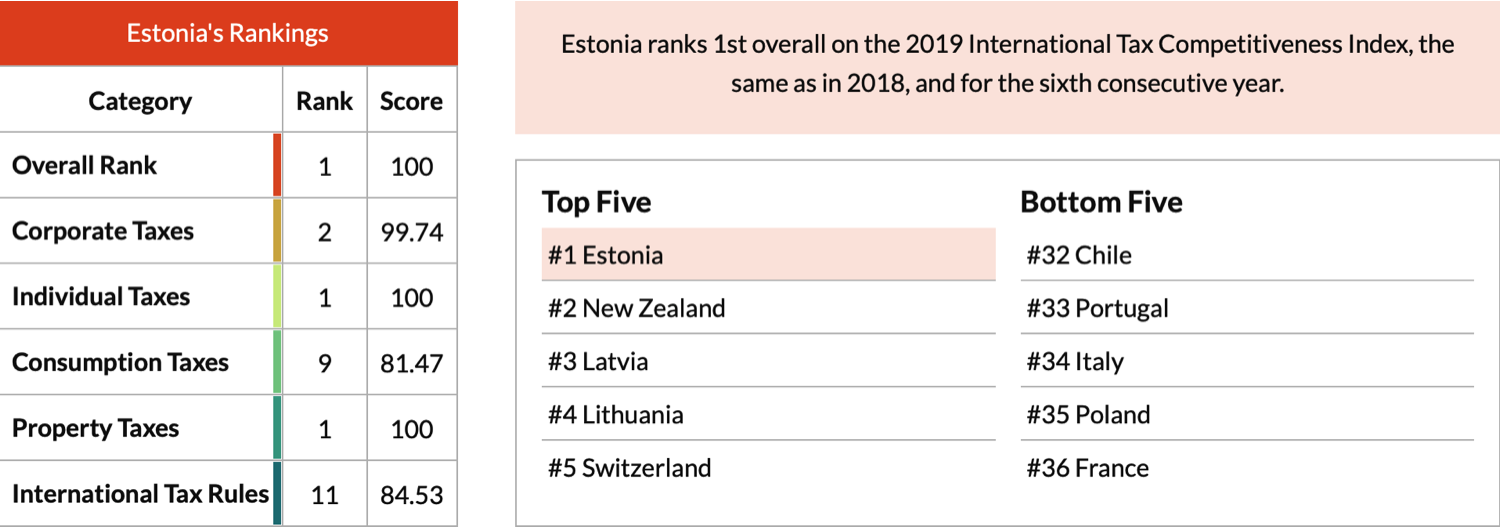
According to Tax foundation, Estonia’s top score in 2019 is driven mainly by four positive features of its tax code:
- It has a 20 per cent tax rate on corporate income (reduced to 14 per cent in case of regular dividends) that is only applied to distributed profits. This means that Estonia’s corporate income tax system allows companies to reinvest their profits tax-free.
- It has a flat 20 percent tax on individual income. The tax us not applied in case of distributed dividends that have already been taxed with a corporate income tax (see above).
- Its property tax applies only to the value of land, rather than to the value of real property or capital.
- It has a territorial tax system that exempts 100 percent of foreign profits earned by domestic corporations from domestic taxation, with few restrictions
A simple tax system means less hassle
A clear advantage of Estonia’s tax system is that companies spend less time on tax compliance than they would in any other country in the OECD. For example, in an average OECD country, 42 hours per year are used by companies to comply with just corporate income taxes. In Estonia, the figure is five hours. Other taxes, such as the value added tax (VAT) also have a low compliance burden.
Estonia is also among the few countries in the OECD that do not have any property transfer taxes, meaning taxes on the transfer of real property (real estate, land improvements, machinery) from one person or firm to another.
Low marginal tax rates create a competitive tax code
According to Tax Foundation, the structure of a country’s tax code is an important determinant of its economic performance. A well-structured tax code is easy for taxpayers to comply with and can promote economic development while raising sufficient revenue for a government’s priorities. A competitive tax code is one that keeps marginal tax rates low.
In today’s globalized world, businesses can choose to invest in any number of countries throughout the world to find the highest rate of return. This means that businesses will look for countries with lower tax rates on investment to maximize their after-tax rate of return.
If a country’s tax rate is too high, it will drive investment elsewhere, leading to slower economic growth. In addition, high marginal tax rates can lead to tax avoidance. According to research from the OECD, corporate taxes are most harmful for economic growth.
The post Estonia has the world’s best tax system. appeared first on Bellone Invest.
]]>The post Estonia is the best country in the world for digital life. appeared first on Bellone Invest.
]]>Estonia ranks 1st out of 68 countries when it comes to the best and worst countries to live a connected life. This is according to the first Digital Life Abroad Report from the biggest online expatriate network, InterNations, which broke down the best and worst countries to live a digital life abroad.
The results, based on the group’s annual expat insider survey, reveal Estonia, Finland, Norway, Denmark and New Zealand are tops when it comes to offering a digital environment. Expats in these countries are very satisfied with their unrestricted access to online services and the possibility to pay without cash almost anywhere.
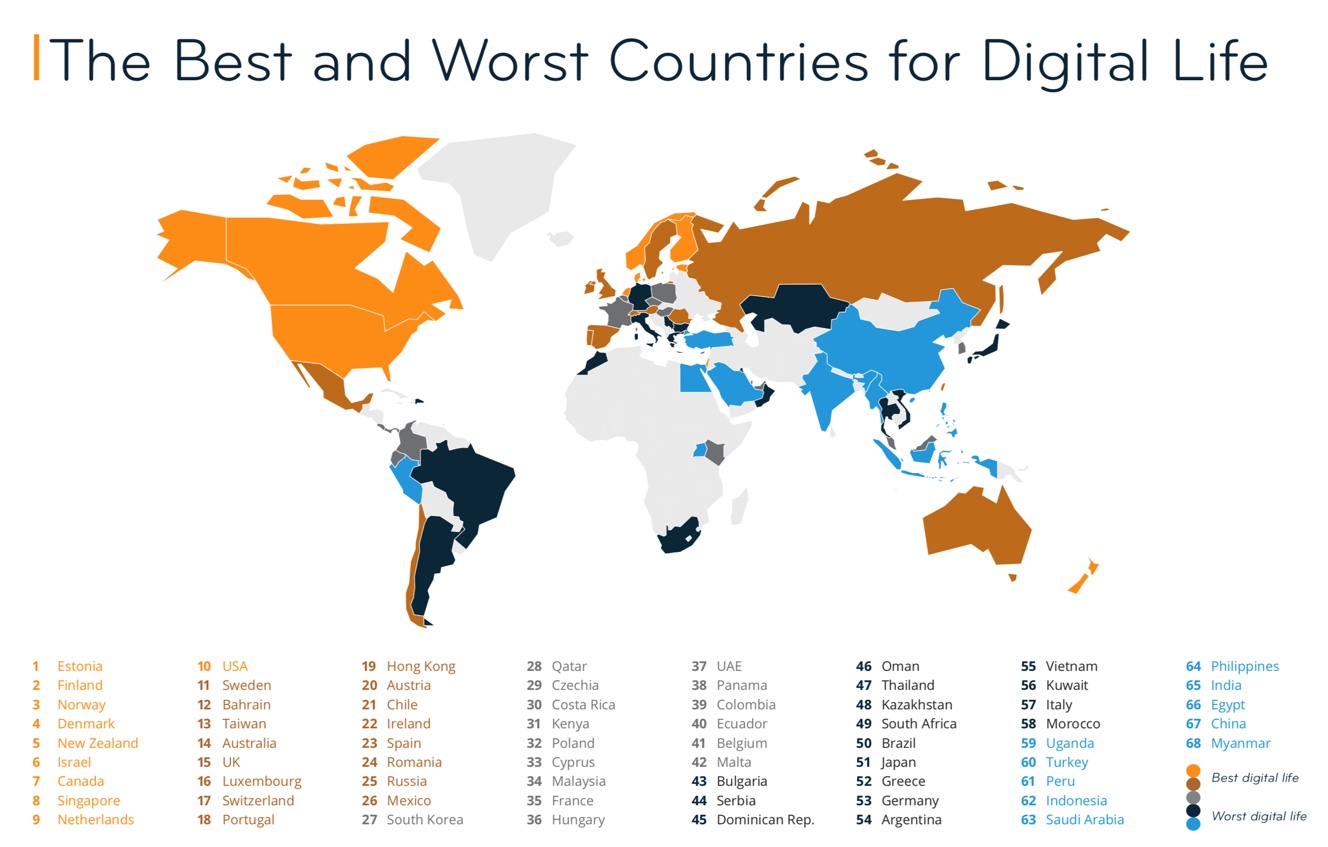
To identify the best and worst countries for digital life, survey respondents were asked to rate their satisfaction with the following factors on a scale of one to seven:
- the unrestricted access to online services such as social media
- the availability of government/administrative services online
- the ease of getting a local mobile phone number
- the ease of paying without cash
- the ease of getting access to high-speed internet at home.
At the other end of the scale, Myanmar, China, Egypt, India and the Philippines are rated the worst countries for digital life. Expats in these countries struggle with a lack of government services online, difficult access to high-speed Internet at home, or even restrictions in their use of online services.
Estonia comes in 1st place in unrestricted access to online services
According to the report, Estonia comes in 1st place out of 68 countries in terms of digital life. The country is rated best in the world for both unrestricted access to online services (e.g. social media) and the availability of administrative or government services online.
In fact, 96% of expats judge the access to online services favorably (vs. 80% globally), with 86% saying it could not be any better (vs. 58% globally).
94% are impressed with the availability of government services online (vs. 55% globally)
In Estonia, 94% are impressed with the availability of administrative or government services online (vs. 55% globally), with 70% giving it the best possible rating (vs. 23% globally). “Expats looking for a country without bureaucratic hurdles need look no further than Estonia”, the report says. This definitely mirrors Estonia´s motto as the world’s most digitally advanced society.
It is easy to pay without cash in the Scandinavian countries
Expats in Scandinavian countries are happy with the ease of paying without cash. As shown above, Estonia ranked 5th after Finland, Denmark, Sweden and Norway. It is true, paying without cash is no issue at all. Shops, cinemas, supermarkets, theatres, concert halls and even busses, trams and trains have card payment options. International and local bank cards are both accepted.
These excellent results help the country compensate its more modest rankings in terms of available leisure options (51st) and travel opportunities (65th). All in all, Estonia comes in a good 21st place out of 68 countries for its general quality of life. Estonia was featured in the Expat Insider survey for the first time.
Estonia also ranked high for family life
For those that are thinking about settling in Estonia with their family, they will be glad to know that Estonia was ranked 11th best country for family life in the annual Expat Insider survey. Quality and cost of education, and family well-being were among the most appreciated qualities of Estonia.
Settling in Estonia has recently become even smoother thanks to the new expat service centre. International House of Estonia provides free personal consultations for foreigners, their families and local employers about settling in, documentation, healthcare, language programs etc. It is located in the capital, Tallinn. Book your appointment online.
The country is attracting more internationals with its clean, safe and tech-savvy environment
According to the recent statistics, the number of international talent in Estonia has more than doubled in the past 5 years. With respect to the European Union, the TOP 5 countries are Finland, Latvia, Germany, Italy and France. With regard to beyond the European Union, the TOP 5 countries are Ukraine, Russia, Belarus, India and Nigeria. People also relocate from the US, the UK, Sweden and other places.
The most popular job offers are in the tech sector.
Expats mostly choose Estonia because of possibility of achieving career goals faster – the country is considered to be Northern Europe’s knowledge hub in tech. Estonia is attracting more internationals as it offers a clean, safe and tech-savvy environment to accelerate the most demanding professional careers. Interested to know more? Have a look at the reasons why international specialists like to live in Estonia.
Estonia has lately received high rankings in press freedom. A recent study showed that compared to other European countries, Estonian children experience fewer internet threats. Moreover, Estonia is the first country in the world to offer e-Residency – a solution that has attracted more than 55k+ e-residents.
The post Estonia is the best country in the world for digital life. appeared first on Bellone Invest.
]]>The post Uber rival Bolt launches food delivery service in Europe appeared first on Bellone Invest.
]]>Competition in Europe’s food delivery market is getting even more heated.
Uber rival Bolt announced Wednesday it will launch a food delivery service in Tallinn, Estonia, where it is headquartered. The Estonian start-up said it would expand the service to Latvia, Lithuania, and South Africa later this year before launching in more markets in Europe and Africa in 2020.
Bolt, formerly known as Taxify, is entering an already-crowded field of competitors in the European food delivery market. Uber Eats and Amazon-backed Deliveroo are aggressively expanding across the region, while Britain’s Just Eat recently agreed to merge with Amsterdam-based Takeaway.com to create the biggest food delivery company outside of China.
Bolt Chief Product Officer Jevgeni Kabanov said in an interview with CNBC Wednesday the company’s strategy with food delivery will be to build on its existing 25 million users and to offer lower delivery prices than competitors. Kabanov added the company will also pay “higher earnings for carriers.”
The company has taken a similar approach in the ride-hailing market, offering steep rider discounts and higher driver commissions. Bolt said the food delivery service would be available through a separate app called Bolt Food.
The Estonian unicorn, which was valued at $1 billion last year, currently operates in 30 countries. Its investors include Chinese ride-hailing firm Didi Chuxing, German automaker Daimler and the entrepreneur and investor Thomas Padovani.
Ride-hailing companies have struggled to cook up profits in the food delivery market thanks to high overhead costs. Earlier this month, Uber CEO Dara Khosrowshahi said he doesn’t expect the company’s Eats business to be profitable in the next two years.
“We would not do it if we did not believe that we have the opportunity to build a profitable business,” Bolt’s Kabanov said.
The post Uber rival Bolt launches food delivery service in Europe appeared first on Bellone Invest.
]]>The post Estonia: a springboard for global startups and AI applications appeared first on Bellone Invest.
]]>Artificial Intelligence is taking the world by storm. Where does Estonia stand in the AI ecosystem? Are Estonian businesses ready for AI?
We know that tech giants like Amazon, Baidu, Facebook and Google have AI advantages like collecting enormous amounts of data, access to top talent, huge investments to R&D, over smaller companies. However, the possibilities offered by AI are not reserved only for the largest companies and biggest economies.
Estonia is looking for ways how to attract international talent and investments; and on the other hand, its small size with limited resources requires the public administration and government to work efficiently. No wonder that in Estonia, both government and companies have noticed the potential of AI technologies to solve these current demographic and economic challenges, as the impact of AI on GDP in the Nordics alone is expected to be considerable: 9.9% of GDP (1.8 trillion).
Where does Estonia stand today in terms of AI readiness?
There is a large spread of AI readiness in Europe, but even the most advanced countries are lagging behind the US AI frontier. Yet, Europe’s ability to capture the full potential of AI varies significantly among countries. According to the mapping of Europe’s AI ecosystem four countries stand out as dominant players in driving Europe’s AI ecosystem — UK, France, Germany and Spain — and are known to have most vibrant and mature AI landscapes in Europe.
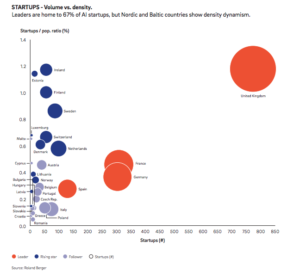
According to study by Roland Berger and France Digitale, Estonia has excellent prerequisites for benefiting from the application of artificial intelligence and is becoming influential AI player in Europe.
Whereas EU leaders of AI application are home to 67% of AI startups, Estonia with other Nordic and Baltic countries shows density dynamism i.e high number of startups per population size.
Compared to dominant players and other governments working on their AI strategies, Estonia sees its strength as an AI implementation leader for startups and AI applications.
For example by 2020 Estonian government has launched 50 different AI applications in public services and the country’s most well-known scaleups (Bolt, TransferWise, Pipedrive) as well as early stage AI-powered startups (Sixfold, AlphaBlues, Feelingstream) have turned to data and machine learning to maximise their product delivery.
At the same time Estonia doesn’t let the AI frenzy and need to speedy implementation of AI compromise data privacy and safety. Estonia plans to keep AI applications safe for its people and for the protection of private data. Estonia wishes to be the place where AI applications are developed in accordance with privacy and safety requirements.
Era of AI implementation
In his book AI Superpowers technologist Kai-Fu Lee argues that “Much of the difficult but abstract work of AI research has been done, and it’s now time for entrepreneurs to roll up their sleeves and get down to the dirty work of turning algorithms into sustainable businesses.”
Which Estonian companies are riding on the implementation wave right now?
But first you might ask, what makes a startup into an “AI startup”. For this article we call both producers and users of artificial intelligence as “AI startups”. It’s hard to calculate the total number of startups and companies in Estonia as AI is not a single technology, but consists of various elements.
Read more here to find out about the 13 examples of AI-powered companies from early stage startups to mature scale-ups, and bring out a few government AI applications that are using data and machine learning to either reshape product, automate, and on the other hand, bring out some more transformative companies who have created new business models with data.
The post Estonia: a springboard for global startups and AI applications appeared first on Bellone Invest.
]]>The post ESTONIA: The inside story of building a digital nation. appeared first on Bellone Invest.
]]>By Charles Orton-Jones
Some facts about Estonia. At the last election, 44 per cent of ballots were cast online. Voters are able to vote on their PC or mobile before polling date, and change their choice as many times as they like. One woman changed her vote 648 times. The police arrived to ask why. She asked whether they had a problem with it; they said no and left her in peace.
All government services are online. And completely connected. Go to a doctor and they can pull up your digital records immediately. No farcical paper Lloyd George envelopes, as with the NHS. Your prescription is entered into an online e-prescription system, accessible to all pharmacies. Just go to the nearest one, present an ID card and collect.
The data in every government department is integrated on a single platform. An ID card, with a 2048-bit encryption chip in it and a four-digit pin, grants access to all services. Voting, paying tax, signing documents, buying tickets for public transport – more than 600 government services can be accessed via the same log-in. What is more remarkable: more than 2,000 private-sector companies are permitted to use the same system. Your grandma can check her bank account in the same way that she votes.
And the most remarkable fact? The entire cost of government IT – including software, hardware and salaries – is less than €100m. By comparison, a single British project, Universal Credit, costs £12.8bn – sorry, £15.8bn as of the latest revision.
Which raises one enormous question: how do they do it?
It’s not down to natural resources. Estonia, with a population of just 1.3 million, is an unlikely candidate for a tech superpower. For 50 years the nation languished under the dark imperialism of Soviet occupation.
And the digital transformation hasn’t happened overnight. I recall my first visit to Estonia on a snowy winter night in 2001. I walked into Tallinn’s old town for the first time and marvelled. It looked like a medieval fairy tale. I was despatched to research an economic report on the country, a fresh-faced young journalist. Yet, even in those early days, the ambition was tangible.
A tech entrepreneur told me back then that he wanted to change the name of the nation to Estonia.com. He wasn’t kidding. Others agreed. The head of the main telco showed me how to pay for parking with a text message. Remember: this was 2001. The foreign secretary told me Estonia had ambitions to become a Nordic nation like Finland and Sweden.
It was bold talk, but was it realistic?
Today, Estonia is the most digitally advanced nation on Earth. The UK, US and EU regularly send emissaries to learn from this tiny country.
For the spring 2019 edition CMI magazine Professional Manager, we spoke to two pioneers to find out the secrets of this e-miracle.
A TECHNICALLY SKILLED NATION
The first, Taavi Kotka , former CIO of Estonia, is a blond-haired extrovert renowned globally as the most eloquent spokesman on what his nation has achieved.
I ask Kotka about the budget and how it’s so incredibly low. “If you don’t use Accenture or McKinsey, you’d be amazed at what you can get done,” he laughs. “We don’t have enough money, so they don’t bother us!” Instead, services were built on a budget, improving slowly. “Estonia used ‘agile’ before ‘agile’ was even invented,” says Kotka. “My own student bachelor’s work was describing prototyping in the year 2000: launch with a barely functional model and then have many iterations a month. Compare this to the waterfall method in the UK. Your problem is you want to solve everything at once.”
A golden rule is that no software used by the Estonian government should be more than 13 years old – even if it works fine. This avoids costly obsolescence. “Most of the money in the UK goes towards keeping up old stuff,” says Kotka. “You never ask if it is optimal. It’s like comparing Uber with a traditional taxi company. Uber is automated and efficient. The other needs secretaries to take calls.”
Estonia wants to be known as a technically skilled nation. It has no choice – there’s no oil here and tourism is limited to the capital. So the country has invested in technology skills. The Estonian IT Academy was established in 2012 in order to improve the quality of ICT training. A revised Aliens Act, approved in the summer of 2013, makes it easier to employ highly qualified foreign ICT specialists in Estonia. The nation is now teeming with impressive startups, such as advertising platform Adcash and jobs website Jobbatical. TransferWise, the currency exchange service valued at more than £1bn, was founded by two Estonians. Skype was built here.
With such a strong IT ecosystem, the government can outsource coding and maintenance of its tech. “Ninety per cent is done by the private sector,” says Kotka.
Underpinning it all is the architecture of the national IT system. The 600 or so departments offering services retain control of their particular user data. So libraries keep library data. Doctors keep medical records. Yes, data can be transferred between the two seamlessly, but it’s what Kotka calls “a distributed architecture. There is no single point of failure. It is, in IT jargon, peer to peer. There is no central hub”. The platform is called X-Road and is so efficient that Finland, Estonia’s linguistic and cultural sister nation, has adopted it.
The code is open source, so anyone can examine or deploy it. The two nations’ systems are interoperable, and they now exchange information on health, tax and customs, traffic and demographics.
Another ingredient: keep politicians out of it. They panic at the first sight of problems, says Kotka. They interfere. And they keep changing. No decent IT project can be run on this basis. “Even Google doesn’t get things right first time. They need to A/B test and do rollbacks to make a product work properly. That is normal product development. Politicians never understood this,” says a clearly chastened Kotka. “One thing I learned: there is no ownership in politics.”
BIG BROTHER HAS PRIVACY PROTOCOLS
There is an obvious objection to all this. If all data is online, and accessible to almost anyone, isn’t there a security risk? And what about the Orwellian state? The UK avoids ID cards for fear of an overbearing government. Estonia suffered under the ‘Sauron eye’ of the USSR. How can its people tolerate the risk of being spied on?
Toomas Hendrik Ilves, Estonia’s president from 2006 to 2016, understands Estonia’s national psyche better than most. He’s also a genuine expert on technology and cybercrime, having been chairman of the EU eHealth Task Force and chairman of the European Cloud Partnership Steering Board.
Talking to Professional Manager from his residence in Stanford, California, where he is a distinguished visiting fellow at the university, Ilves says Estonians don’t worry about ID cards in the same way as Brits. “There is a clear cognitive break between the government and an operating system. Estonians dislike whoever is in power as much as anyone. A priori, if you are in government you are an idiot, stupid, corrupt – that is no different. But it’s similar to the way you see the police. They are not the government.”
STRICT ON SECURITY
The X-Road system is designed to allay privacy concerns by being totally transparent. All interactions are logged, Ilves explains. Citizens can see immediately who has looked at their data. “We had one famous case where a systems administrator with the police abused her authority. She checked up on her boyfriend. The police are not allowed to do this. She was fired and convicted of a felony.”
So the system is open, but infractions of the rules are severely punished. “Our health records are stored online, and I can grant legal access to medical professionals. If anyone else tries to, it sets off bells and whistles.”
If anything, the system is more trustworthy than Google’s or Apple’s. We entrust our emails, our search history and even our geographic location via our phone to a tech company located abroad. Yet we have little knowledge of how our data is accessed or monetised. In Estonia, all activity is available online for citizens to review.
And cyberattacks? Estonians have good reason to worry. The country has been physically conquered five times in its history, and the Russians over the border are a constant menace. Russian tanks entered both Georgia and Ukraine in recent memory, making this little Baltic state rather nervous. In 2007, Russia launched a cyberattack on Estonia, crippling services.
For Ilves, that incident proved the strength of their system. “They never got in. It was a DDoS, a denial of service attack. You couldn’t access your newspaper or your bank, but the government system didn’t collapse. There was no breach.” The distributed architecture of Estonia’s X-Road platform meant the attack was diluted across many nodes on the network. If a single node got knocked out, the others would continue just fine. It worked.
In fact, it needed to triumph. Because at the very heart of Estonia’s IT system is a challenge to what it means to be a nation state. Estonia is a country with land borders. But, if Russia invades, the nation may need to reconvene outside the zone of occupation. A purely digital government, with everything backed up in the cloud, can be rebooted from anywhere – citizens minus the land. Servers in Luxembourg hold a complete set of records, just in case.
And when borders disappear from the citizenship equation, interesting things start to happen. Citizens from other nations, for example, can become e-citizens – which is what Estonia offers. There are citizens of other nations who have become a sort of honorary digital Estonian. “We already had the infrastructure,” says Kotka, “so it didn’t cost us anything.”
ONE WAY TO GET AROUND BREXIT?
To become an e-resident, go online to e-estonia.com, and fill out the form. Then collect an ID card from the nearest embassy or consulate. The card provides access to all Estonian services, just like an Estonian. Start a company, access banking and sign digital documents with your Estonian ID. The Mayor of London’s entrepreneurs of the year in 2017, Ellenor McIntosh and Alborz Bozorgi, founders of eco-friendly wet wipe brand Twipes, created an Estonian company this way to avoid Brexit complications.
Estonia’s early goal was to sign up ten million e-residents – almost ten times the physical population of Estonia.
Tech people love to talk about disruptive startups. Estonia is the first disruptive nation, rethinking what it means to be a country.
It’s clear that Estonia leads the UK in more than a purely technical sense. It is using technology to reflect on the philosophy of nationhood. Catching up will require more than adding extra zeros to our IT budget.
The post ESTONIA: The inside story of building a digital nation. appeared first on Bellone Invest.
]]>The post Year 2018: Records for the Estonian startup sector & support of the ecosystem appeared first on Bellone Invest.
]]>There are currently around 550 startups in Estonia from a variety of sectors including Fintech, Greentech and beyond. While looking at the main indicators – number of people employed (3763 in 2018), employment taxes paid (46M EUR in 2018) – we are seeing a steady 30% yearly growth in the sector.
The top 20 startups in Estonia account for an astonishing 62% of the new jobs created by startups in 2018. TransferWise has been the biggest recruiter (+239) followed by Bolt (formerly Taxify) (+92), Monese (+57), Veriff (+54) and Pipedrive (+53).
Another important element of a successful startup ecosystem are investments. Since 2010, the proportion of investments raised from abroad for Estonian startups has been growing year-by-year, reaching the highest percentage in 2018 (96.3%). The increased interest of foreign investors confirms that Estonian startups are being noticed globally, we have a strong startup ecosystem and a credible, transparent, business environment.
In 2018, investments into Estonian startups have, for the first time, exceeded 300M EUR, reaching 328M EUR announced publicly. By far the biggest investment (150M EUR) was made into Bolt (formerly Taxify) and that investment round upgraded Bolt to unicorn status. Bolt was followed by Pipedrive (43M EUR+8.7M EUR), Monese (51.6M EUR), Starship Technologies (21.4M EUR) and Realeyes (13.5M EUR). So far, Estonia has produced four billion-dollar unicorns: Skype, Playtech, TransferWise and Bolt as well as a dozen other startups valued over 100M EUR each.
Estonian startup ecosystem might be small but it is very international. The key role of increasing the international community over the past two years has been performed by the Estonian Startup Visa. The Startup Visa helps non-EU founders grow their startup in Estonia and it also makes it easy for Estonian startups to hire non-EU talent. In the first two years since the launch, 1108 applications were received from more than 80 countries and 931 people altogether have relocated to Estonia or been granted the right to do so. Although we are expecting more and more founders to find their way to Estonia and become employers themselves, it is clear that the need for talent in Estonian startups is growing significantly. 2018 was a record year of investments in Estonian startups; the funds are directly connected to the increase in available jobs. There are jobs available not only for developers but also marketers, sales people, customer support, designers, etc.
A huge role in the development of our startup ecosystem is played by organisations and service providers who support the growth of our startups. At the end of 2018 we counted 103 such organisations, meaning we have roughly 1 organisation per 5 startups! The ‘’by-product’’ of support organisations is a strong giving-back mentality within its network of mentors, with entrepreneurs who have been active for more than 10 years in Estonian startups like Fortumo, TransferWise, Bolt, Starship Technologies and Pipedrive. The strength of our ecosystem is definitely its people – thought leaders who help to shape the ecosystem with new endeavours.
Source: Invest in Estonia
The post Year 2018: Records for the Estonian startup sector & support of the ecosystem appeared first on Bellone Invest.
]]>The post How Estonia became one of the world’s most advanced digital societies? appeared first on Bellone Invest.
]]>How Estonia became one of the world’s most advanced digital societies from CNBC.
The post How Estonia became one of the world’s most advanced digital societies? appeared first on Bellone Invest.
]]>