The post Investor insights from Thomas Padovani appeared first on Bellone Invest.
]]>A Funderbeam exclusive interview with Thomas Padovani. He is an entrepreneur and investor. Thomas co-founded the Webinfluence Group in 2007, then went on to found the globally successful online media advertising platform Adcash. Stepping back from the Adcash CEO position in 2018, Thomas now focuses on building and investing in new aspiring startups with growth opportunities. Now he is a lead investor for Punch Drinks funding campaign.
As an early stage investor, what questions do you always ask when looking at a business and its management team?
The thing is that I have been through the same stage as they would experience during their growth, therefore it’s quite natural to ask yourself what I would do if I would be in their shoes at the moment. Seeing similarities, affinities, or familiar behavior is something that would make you confident to make the investment.
BUT! That’s not enough, bringing things too close to your heart will lead to emotions. Emotions are very important; but decisions resulting strictly from our emotions can lead to mistakes. This is what Elon Musk calls “wishful thinking”.
More rationally, going through these stages also brought me a lot of experience that I’m using to understand, in a better way, the challenges that the team will face.
Sectors are different; but challenges can be categories in the same way. The industry, the people, the regulation, the trends, and the economic situation. Financials and business plans are important in the rational part of the decision making.
What is the biggest lesson you have learned in investing in early-stage companies?
Two words, “Human factor”. Focusing only on the potentials that the market is giving or the financial data at a certain point give a shortened and misleading overview. Bottom line the humans behind the idea, concept, businesses are the ones that will make the mistakes, and there, nothing is taken for granted. Pick the right humans with the right ideas.
Are you sector agnostic when it comes to making investments as long as they meet your criteria?
We have usually a preference for SaaS and Softwares, but we are looking as well in a wider range of opportunities.
What is the tipping point to you when you decide in favour of investing?
The momentum is basically between Company potential/growth versus current valuation.
Can you tell us about some of your favourite companies in your portfolio?
What areas do you think will present the most opportunity for early-stage investors over the next 18–24 months?
Softwares, health, entertainment, finance.
Where are you seeing the most exciting early stage opportunities? What are the ‘ones to watch’/ most currently underrated?
Estonia provides quite a lot of opportunities for investors in different sectors.
What are your fears as an investor?
Human Factor as described earlier
A book to read or a blog or podcast to follow…
How did you discover Funderbeam?
Through media coverage and successful fundraising of the start-up that was looking at.
What is Funderbeam to you?
A good tool for a start-up to get known and raise funds.
Questions from Kaidi Ruusalepp, Funderbeam CEO and Founder:
1) If you could be a founder/CEO of any company in the world, what would this be and why?
IKEA, because the model is close to perfection.
2) Would you like to win the Nobel prize, Oscar or Olympic gold medal? Why?
None of the listed above but 1st position at 24h of Le Mans would be a great achievement.
Why? Because after all we love winning and all entrepreneurs must be competitors in their soul.
3) If there’s 1 question in the world where the universe provides you the correct answer, then what would this question be?
What happens after we die.
Question from previous respondent Madis Müür:
1) What’s your superpower or secret sauce, how do you help your companies?
As an investor, we must first help people not investing in companies that we believe will not work. It saves time for every one.
Otherwise, when we invest in a company we share our contacts, experience, and whatever is necessary but we don’t interfere. We provide the fuel when necessary the engine is the team.
Article source and credits by Funderbeam. Visit the original article here
The post Investor insights from Thomas Padovani appeared first on Bellone Invest.
]]>The post Adcash founders invested in Estonian beverage manufacturer to produce disinfectants during the crisis. appeared first on Bellone Invest.
]]>Estonian beverage manufacturer Punch Drinks started manufacturing disinfectants in order to help contain the spread of COVID-19 virus in Estonia. The sanitizers are available in e-shop, Bolt Food and soon pharmacies across Estonia.
„In the light of the corona virus we decided that it is our duty to help our country and people in these difficult times. We had the production capacity and capability, so shifting temporarily our strategy seemed the only reasonable thing to do,“ said Kristjan-Walter Kask, the CEO of Punch Drinks.
Punch Drinks, whose main products are organic craft soft drinks and cocktails, quickly familiarized themselves with the regulations and requirements needed for the disinfectant manufacturing and rearranged their current production processes. “We didn’t hesitate in the production for a second, but were dependent on how we could obtain the needed permits and certificates. We’re glad that the Health Board was on board from the minute we contacted them and fastened the bureaucratic processes to issue the certificates,” explained Kask. He added that Punch Sanitizers are officially approved by the Health Board, for which the biocidal product registration has been issued.
Entrepreneurs share the responsibility to help during crisis
To increase the production capability, Thomas Padovani together with the Webinfluence Group and Bellone Invest made a quick investment decision, when heard that Punch Drinks wanted to expand their activity. “I strongly believe that all entrepreneurs have a responsibility to help to fight this virus, if possible. We appreciate Punch Drinks’s commitment to contribute to the community and safety of all of us,” explained Thomas Padovani. He added that even though they currently invested to help to increase the production of sanitizers, they see great potential of Punch Drinks becoming a strong player. “The ambitions of Punch are strong in our region. There is a clear market demand for organic crafted drinks elaborated by top bar tenders,” noted Padovani.
Padovani brought out that during the crisis they try to be there for all their current investments and partners to go through the crisis together. “Nobody knows at the moment how deep the fall will exactly be. One could never imagine that the world and economy could be paused like this, so this is completely a new situation. Therefore, we do our best to help to ease the situation for our partners,” said Padovani.
Available in e-shop, Bolt Food and pharmacies
Punch Sanitizer antiseptic sprays effectively kill bacteria, yeasts, mold and viruses. In addition, the product is colourless and fragrance-free, and suitable for both professional and home use. “Today we are able to produce around 4000L of sanitizers a day, but we hope to increase that up to 6000L a day. We do our best to ensure the supply of raw materials, which is very unpredictable in today’s circumstances,” said Kask.
He noted that if they find a partner abroad they could also start exporting. “At the moment we have the biocidal product permit only for Estonia and currently there is no single Estonian company who has been listed as biocidal producers abroad. If we find a partner, who would have needed licenses, then we would be ready to export,” explained Kask.
Currently the sanitizers are sold in Punch Drinks e-shop in different sizes and quantities, but soon also available in Bolt Food and pharmacies. “We have sealed a deal with Magnum Medical, which means that our sanitizers will be available in pharmacies across Estonia. We’re actively searching for new retailers to make the product available to all citizens and companies in need,” stressed Kask. He added that their goal is not to earn easy income during the crisis and therefore have kept their pricing reasonable and competitive.
Additional information: https://punch-drinks.com/sanitizer
The post Adcash founders invested in Estonian beverage manufacturer to produce disinfectants during the crisis. appeared first on Bellone Invest.
]]>The post The booming Baltic startup scene appeared first on Bellone Invest.
]]>Baltic startups have created over €5 billion in value since 2013. 2018 was a record year for VC Investments in the Baltic states. The total amount of VC raised by companies in the Baltic States hit €534 million in 2018.
Across the Baltics, over €1.5 billion has been invested since 2013, as a result of several large VC rounds such as Bolt, Citybee, Monese, Vinted, Pipedrive, Starship. And its showing a substantial growth since 2013.
Venture Capital investments average growth from 2013 has been rising +88% in Estonia, while Lithuania’s growth rate is booming with +135%. Latvia is still in very moderate stages regarding startup growth and VC investments, compared to Estonia and Lithuania.
By invested venture capital, Estonia is still ranking #1, with €1,173B, while Lithuania is ranking #4 with €375M, according to the latest report.
One-third of the total unicorns in Central & Eastern Europe are created in the Baltics.
The Baltic region has created one third of total unicorns in Central & Eastern Europe, and 3% of unicorns in total Europe, worth a combined €12 billion. Estonia is leading the way in Baltics, with 4 unicorns: Bolt, TransfereWise, Playtech and Skype. While Lithuania has just crowned it’s first Unicorn Vinted, who raised €128M in a funding round that valued it at more than 1 billion euros, making it Lithuania’s first tech unicorn.
“For investors, it is surely interesting to keep a look-out to the Baltic and Northern European countries. Estonia has created a strong and proven track record of successful startups and is still strongly moving forward. But it is worth mentioning to keep a strong eye on the other booming countries, such as Lithuania and Latvia, who are showing a growing number of rising stars”, says Thomas Padovani from Bellon Invest.
The future looks promising
The investments into Estonian startups are still strongly on the rise and the proven track record of creating internationally successful businesses, creates trust for future growth. “Of course, as the first digital nation on the planet, this also creates extra buzz and attracts more interest to look into Estonia,” says Padovani.
It is already clearly seen that the interest from foreign Investors is increasing in Lithuanian tech startups, especially from Western Europe and the USA. Like Estonia, as the leading country of digital technology and startup business scene, Lithuania is also strongly rising up with their business favourable & regulation friendly environment.
For more details, take a look at the report by Dealroom.co for more insights on the Baltic countries startup ecosystem.
Thomas Padovani, after stepping down from the CEO position of Adcash, is now strongly focusing on investing in to startups all over the world through his investment company Bellone Invest, keeping a strong eye and interest on the booming Baltic startup scene. Thomas Padovani, together with Webinfluence Group, was one of the first investors to the Estonian Unicorn Bolt.
The post The booming Baltic startup scene appeared first on Bellone Invest.
]]>The post Thomas Padovani together with several Estonian entrepreneurs invested €600 000 in Estonian startup ProcurementFlow appeared first on Bellone Invest.
]]>Adcash founder Thomas Padovani was one of the investors who invested €600 000 through his investment company Bellone Invest into Estonian new startup ProcurementFlow, which aims to digitise procurement process with its cloud-based software and therefore turn the biggest cost function into a profit generator.
“Procurement is one of the most critical cost function of each company or public institution, which can cause production to stop, quality issues, performance issues and all lead to financial impact on the companies. The power of AI and the evolved knowledge about User interface management force all the industries to rethink themselves. There is room in many industries today for modernising the tools companies are using. ProcurementFlow is solving a real problem and participating to this modernisation process, that’s the reason why we investe in it,” said Padovani.
Innovating the future of procurement
ProcurementFlow is an Estonian Software as a Service (SaaS) provider that aims to digitise the entire procurement process and therefore not only bypass the frustration that comes with it, but also save money. CEO of ProcurementFlow Tarmo Saidla, who previously led the sourcing and supply chain analysis at the global industrial group ABB, said that sourcing and selecting goods involves usually many rounds of research, requests, negotiation and approval, which is a lot of room for miscommunication, misalignment and confusion. “Europe has about 30 000 manufacturers that tailor-make products based on customer requirements, and each purchase must go through a procurement process. On average 43 percent of all costs go through procurement function making it the biggest cost function for each company,” said Saidla. He stressed that with the new service companies not only save money but can also reduce time-to-market for new products and services as well as enable supplier-led innovation.
Contributing to the Estonian digital success story
After leaving the position of Adcash CEO Thomas Padovani has been actively investing to different ventures through his investment company Bellone Invest. The investment strategy is focused on yield generation and long-term investment performances. “When choosing our next investments, we always strive for entrepreneurs that are solving real problems, this is what the market is always buying : cost effective or yield generating solutions” explained Padovani. He stressed that investing to Estonian companies is close to his heart as considers Estonia to be his home. “I’m very proud of participating to the Estonian digital success story before with Adcash and now by helping promising ventures to grow. “ said Padovani. Bellone Invest has also invested in other Estonian companies like Natufia, Zlick, Modera. Padovani and Webinfluence Group are one of the first investors in the Estonian Unicorn Bolt.
The investment round for ProcurementFLow was led by Lemonade Stand, a new angel investment fund in Estonia together with well-known investors like Pipedrive co-founder Martin Henk, Bolt co-founder Martin Villig, Skeleton Technologies founders Taavi Madiberk and Oliver Ahlberg, Katana MRP co-founder Kristjan Vilosius and Stagnation Lab. In total the company raised €600,000 of funding.
The post Thomas Padovani together with several Estonian entrepreneurs invested €600 000 in Estonian startup ProcurementFlow appeared first on Bellone Invest.
]]>The post Estonia has the world’s best tax system. appeared first on Bellone Invest.
]]>Tax Competitiveness Index 2019: Estonia has the world’s best tax system – no corporate income tax, no capital tax, no property transfer taxes
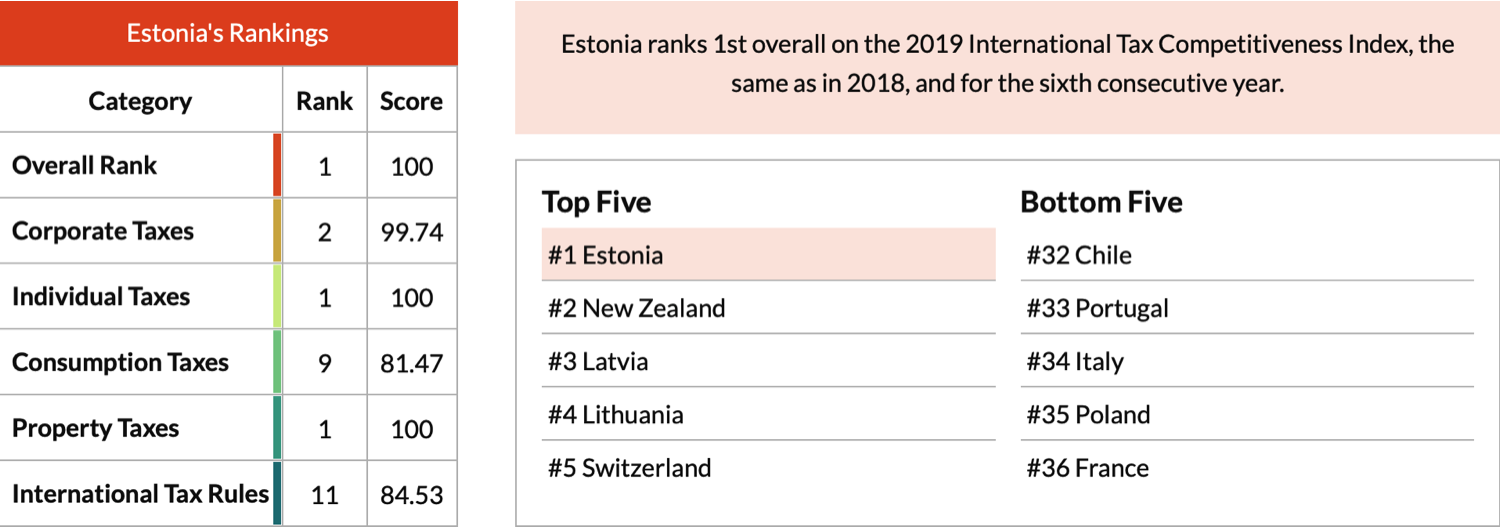
According to Tax foundation, Estonia’s top score in 2019 is driven mainly by four positive features of its tax code:
- It has a 20 per cent tax rate on corporate income (reduced to 14 per cent in case of regular dividends) that is only applied to distributed profits. This means that Estonia’s corporate income tax system allows companies to reinvest their profits tax-free.
- It has a flat 20 percent tax on individual income. The tax us not applied in case of distributed dividends that have already been taxed with a corporate income tax (see above).
- Its property tax applies only to the value of land, rather than to the value of real property or capital.
- It has a territorial tax system that exempts 100 percent of foreign profits earned by domestic corporations from domestic taxation, with few restrictions
A simple tax system means less hassle
A clear advantage of Estonia’s tax system is that companies spend less time on tax compliance than they would in any other country in the OECD. For example, in an average OECD country, 42 hours per year are used by companies to comply with just corporate income taxes. In Estonia, the figure is five hours. Other taxes, such as the value added tax (VAT) also have a low compliance burden.
Estonia is also among the few countries in the OECD that do not have any property transfer taxes, meaning taxes on the transfer of real property (real estate, land improvements, machinery) from one person or firm to another.
Low marginal tax rates create a competitive tax code
According to Tax Foundation, the structure of a country’s tax code is an important determinant of its economic performance. A well-structured tax code is easy for taxpayers to comply with and can promote economic development while raising sufficient revenue for a government’s priorities. A competitive tax code is one that keeps marginal tax rates low.
In today’s globalized world, businesses can choose to invest in any number of countries throughout the world to find the highest rate of return. This means that businesses will look for countries with lower tax rates on investment to maximize their after-tax rate of return.
If a country’s tax rate is too high, it will drive investment elsewhere, leading to slower economic growth. In addition, high marginal tax rates can lead to tax avoidance. According to research from the OECD, corporate taxes are most harmful for economic growth.
The post Estonia has the world’s best tax system. appeared first on Bellone Invest.
]]>The post Estonia is the best country in the world for digital life. appeared first on Bellone Invest.
]]>Estonia ranks 1st out of 68 countries when it comes to the best and worst countries to live a connected life. This is according to the first Digital Life Abroad Report from the biggest online expatriate network, InterNations, which broke down the best and worst countries to live a digital life abroad.
The results, based on the group’s annual expat insider survey, reveal Estonia, Finland, Norway, Denmark and New Zealand are tops when it comes to offering a digital environment. Expats in these countries are very satisfied with their unrestricted access to online services and the possibility to pay without cash almost anywhere.
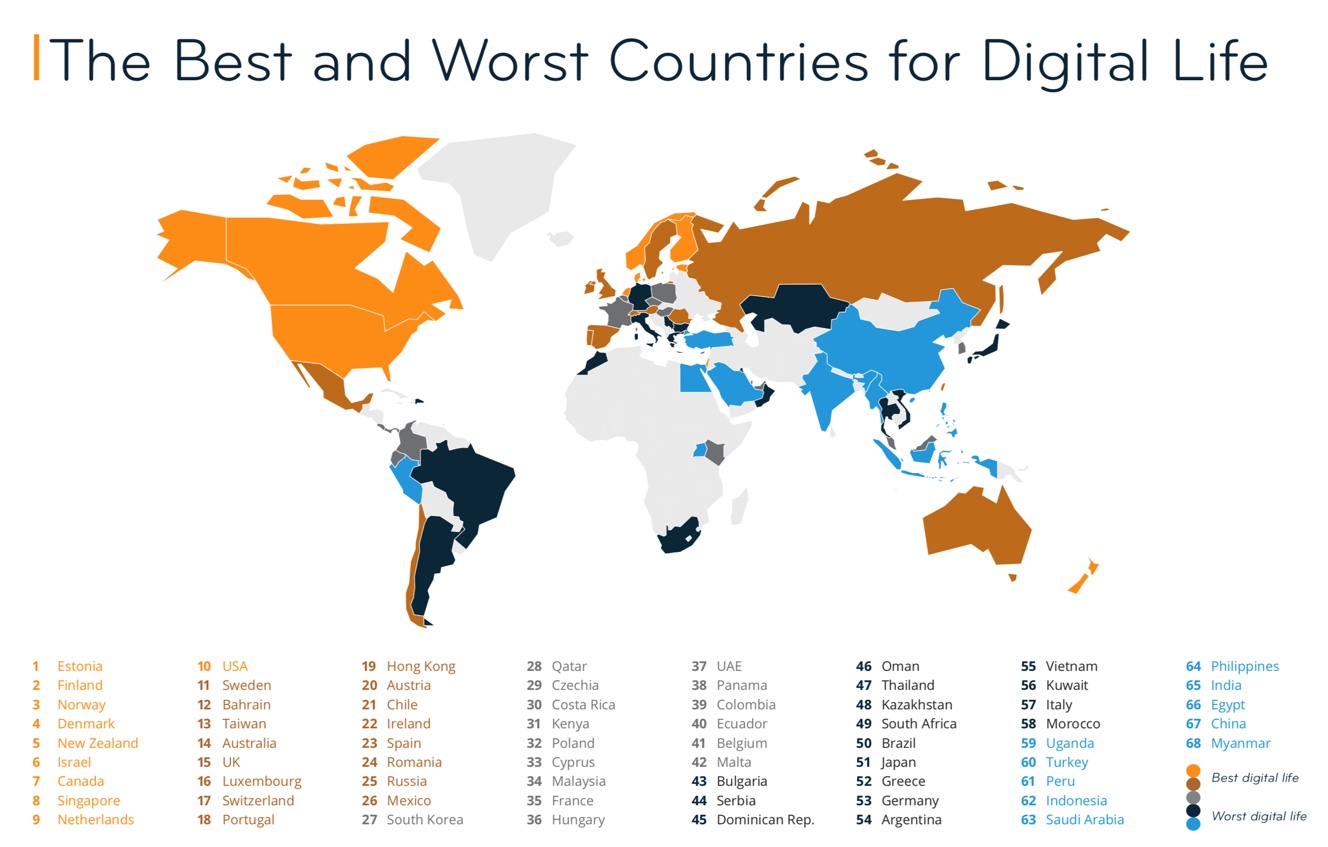
To identify the best and worst countries for digital life, survey respondents were asked to rate their satisfaction with the following factors on a scale of one to seven:
- the unrestricted access to online services such as social media
- the availability of government/administrative services online
- the ease of getting a local mobile phone number
- the ease of paying without cash
- the ease of getting access to high-speed internet at home.
At the other end of the scale, Myanmar, China, Egypt, India and the Philippines are rated the worst countries for digital life. Expats in these countries struggle with a lack of government services online, difficult access to high-speed Internet at home, or even restrictions in their use of online services.
Estonia comes in 1st place in unrestricted access to online services
According to the report, Estonia comes in 1st place out of 68 countries in terms of digital life. The country is rated best in the world for both unrestricted access to online services (e.g. social media) and the availability of administrative or government services online.
In fact, 96% of expats judge the access to online services favorably (vs. 80% globally), with 86% saying it could not be any better (vs. 58% globally).
94% are impressed with the availability of government services online (vs. 55% globally)
In Estonia, 94% are impressed with the availability of administrative or government services online (vs. 55% globally), with 70% giving it the best possible rating (vs. 23% globally). “Expats looking for a country without bureaucratic hurdles need look no further than Estonia”, the report says. This definitely mirrors Estonia´s motto as the world’s most digitally advanced society.
It is easy to pay without cash in the Scandinavian countries
Expats in Scandinavian countries are happy with the ease of paying without cash. As shown above, Estonia ranked 5th after Finland, Denmark, Sweden and Norway. It is true, paying without cash is no issue at all. Shops, cinemas, supermarkets, theatres, concert halls and even busses, trams and trains have card payment options. International and local bank cards are both accepted.
These excellent results help the country compensate its more modest rankings in terms of available leisure options (51st) and travel opportunities (65th). All in all, Estonia comes in a good 21st place out of 68 countries for its general quality of life. Estonia was featured in the Expat Insider survey for the first time.
Estonia also ranked high for family life
For those that are thinking about settling in Estonia with their family, they will be glad to know that Estonia was ranked 11th best country for family life in the annual Expat Insider survey. Quality and cost of education, and family well-being were among the most appreciated qualities of Estonia.
Settling in Estonia has recently become even smoother thanks to the new expat service centre. International House of Estonia provides free personal consultations for foreigners, their families and local employers about settling in, documentation, healthcare, language programs etc. It is located in the capital, Tallinn. Book your appointment online.
The country is attracting more internationals with its clean, safe and tech-savvy environment
According to the recent statistics, the number of international talent in Estonia has more than doubled in the past 5 years. With respect to the European Union, the TOP 5 countries are Finland, Latvia, Germany, Italy and France. With regard to beyond the European Union, the TOP 5 countries are Ukraine, Russia, Belarus, India and Nigeria. People also relocate from the US, the UK, Sweden and other places.
The most popular job offers are in the tech sector.
Expats mostly choose Estonia because of possibility of achieving career goals faster – the country is considered to be Northern Europe’s knowledge hub in tech. Estonia is attracting more internationals as it offers a clean, safe and tech-savvy environment to accelerate the most demanding professional careers. Interested to know more? Have a look at the reasons why international specialists like to live in Estonia.
Estonia has lately received high rankings in press freedom. A recent study showed that compared to other European countries, Estonian children experience fewer internet threats. Moreover, Estonia is the first country in the world to offer e-Residency – a solution that has attracted more than 55k+ e-residents.
The post Estonia is the best country in the world for digital life. appeared first on Bellone Invest.
]]>The post Estonia: a springboard for global startups and AI applications appeared first on Bellone Invest.
]]>Artificial Intelligence is taking the world by storm. Where does Estonia stand in the AI ecosystem? Are Estonian businesses ready for AI?
We know that tech giants like Amazon, Baidu, Facebook and Google have AI advantages like collecting enormous amounts of data, access to top talent, huge investments to R&D, over smaller companies. However, the possibilities offered by AI are not reserved only for the largest companies and biggest economies.
Estonia is looking for ways how to attract international talent and investments; and on the other hand, its small size with limited resources requires the public administration and government to work efficiently. No wonder that in Estonia, both government and companies have noticed the potential of AI technologies to solve these current demographic and economic challenges, as the impact of AI on GDP in the Nordics alone is expected to be considerable: 9.9% of GDP (1.8 trillion).
Where does Estonia stand today in terms of AI readiness?
There is a large spread of AI readiness in Europe, but even the most advanced countries are lagging behind the US AI frontier. Yet, Europe’s ability to capture the full potential of AI varies significantly among countries. According to the mapping of Europe’s AI ecosystem four countries stand out as dominant players in driving Europe’s AI ecosystem — UK, France, Germany and Spain — and are known to have most vibrant and mature AI landscapes in Europe.
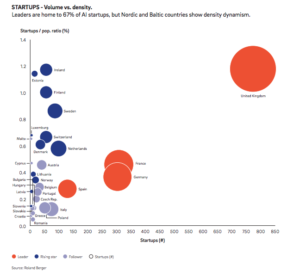
According to study by Roland Berger and France Digitale, Estonia has excellent prerequisites for benefiting from the application of artificial intelligence and is becoming influential AI player in Europe.
Whereas EU leaders of AI application are home to 67% of AI startups, Estonia with other Nordic and Baltic countries shows density dynamism i.e high number of startups per population size.
Compared to dominant players and other governments working on their AI strategies, Estonia sees its strength as an AI implementation leader for startups and AI applications.
For example by 2020 Estonian government has launched 50 different AI applications in public services and the country’s most well-known scaleups (Bolt, TransferWise, Pipedrive) as well as early stage AI-powered startups (Sixfold, AlphaBlues, Feelingstream) have turned to data and machine learning to maximise their product delivery.
At the same time Estonia doesn’t let the AI frenzy and need to speedy implementation of AI compromise data privacy and safety. Estonia plans to keep AI applications safe for its people and for the protection of private data. Estonia wishes to be the place where AI applications are developed in accordance with privacy and safety requirements.
Era of AI implementation
In his book AI Superpowers technologist Kai-Fu Lee argues that “Much of the difficult but abstract work of AI research has been done, and it’s now time for entrepreneurs to roll up their sleeves and get down to the dirty work of turning algorithms into sustainable businesses.”
Which Estonian companies are riding on the implementation wave right now?
But first you might ask, what makes a startup into an “AI startup”. For this article we call both producers and users of artificial intelligence as “AI startups”. It’s hard to calculate the total number of startups and companies in Estonia as AI is not a single technology, but consists of various elements.
Read more here to find out about the 13 examples of AI-powered companies from early stage startups to mature scale-ups, and bring out a few government AI applications that are using data and machine learning to either reshape product, automate, and on the other hand, bring out some more transformative companies who have created new business models with data.
The post Estonia: a springboard for global startups and AI applications appeared first on Bellone Invest.
]]>