The post Estonia has the world’s best tax system. appeared first on Bellone Invest.
]]>Tax Competitiveness Index 2019: Estonia has the world’s best tax system – no corporate income tax, no capital tax, no property transfer taxes
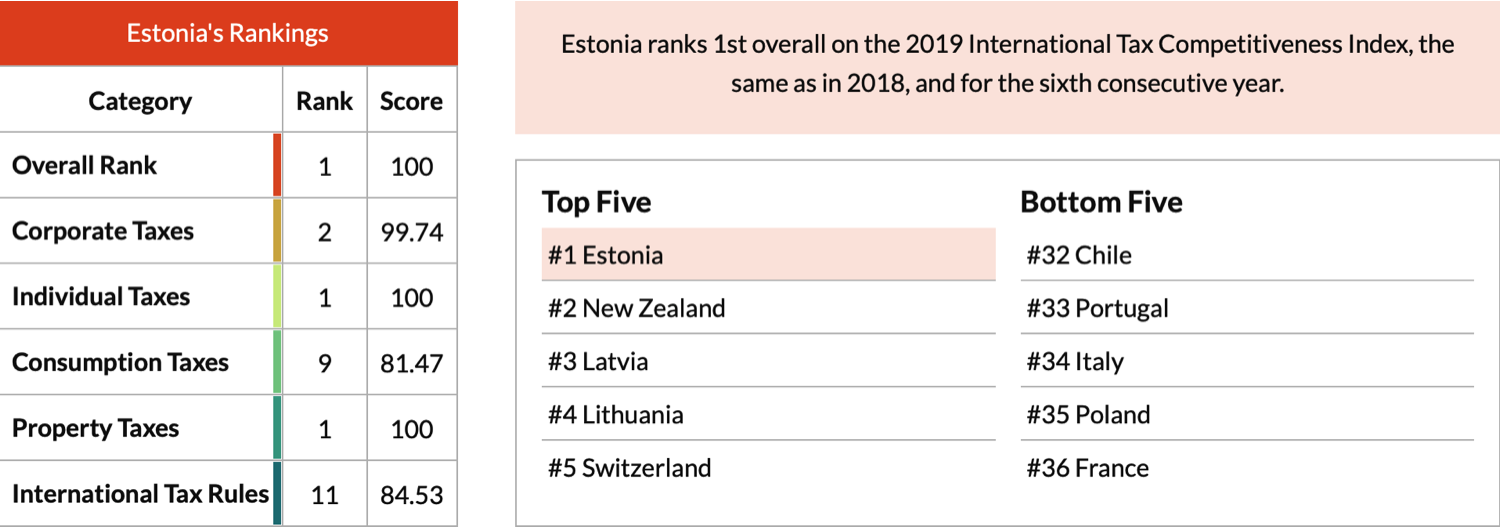
According to Tax foundation, Estonia’s top score in 2019 is driven mainly by four positive features of its tax code:
- It has a 20 per cent tax rate on corporate income (reduced to 14 per cent in case of regular dividends) that is only applied to distributed profits. This means that Estonia’s corporate income tax system allows companies to reinvest their profits tax-free.
- It has a flat 20 percent tax on individual income. The tax us not applied in case of distributed dividends that have already been taxed with a corporate income tax (see above).
- Its property tax applies only to the value of land, rather than to the value of real property or capital.
- It has a territorial tax system that exempts 100 percent of foreign profits earned by domestic corporations from domestic taxation, with few restrictions
A simple tax system means less hassle
A clear advantage of Estonia’s tax system is that companies spend less time on tax compliance than they would in any other country in the OECD. For example, in an average OECD country, 42 hours per year are used by companies to comply with just corporate income taxes. In Estonia, the figure is five hours. Other taxes, such as the value added tax (VAT) also have a low compliance burden.
Estonia is also among the few countries in the OECD that do not have any property transfer taxes, meaning taxes on the transfer of real property (real estate, land improvements, machinery) from one person or firm to another.
Low marginal tax rates create a competitive tax code
According to Tax Foundation, the structure of a country’s tax code is an important determinant of its economic performance. A well-structured tax code is easy for taxpayers to comply with and can promote economic development while raising sufficient revenue for a government’s priorities. A competitive tax code is one that keeps marginal tax rates low.
In today’s globalized world, businesses can choose to invest in any number of countries throughout the world to find the highest rate of return. This means that businesses will look for countries with lower tax rates on investment to maximize their after-tax rate of return.
If a country’s tax rate is too high, it will drive investment elsewhere, leading to slower economic growth. In addition, high marginal tax rates can lead to tax avoidance. According to research from the OECD, corporate taxes are most harmful for economic growth.
The post Estonia has the world’s best tax system. appeared first on Bellone Invest.
]]>